

COSMOS Events
COSMOS ONLINE SEMINAR SERIES: TIME SERIES 101 - A Journey from Sensor to Structure
Every building that survives an earthquake owes its performance to the data captured the instant the ground moved. This eight-part series traces that journey — from sensor to structure — built for the next generation of engineers, seismologists, and geologists ready to work across the lines that usually separate these fields.
WHEN: Wednesdays · 12:00 PM PT Oct 7 – Dec 9, 2026 (1 Hour Sessions)
TO REGISTER: https://givebutter.com/cosmos-time-series-2026
Oct 7
01 The Why: Defining Dynamic
Why do we need processed time series? Real-world applications in
building codes and risk analysis, and the fundamentals of time
history analysis for structural dynamics.
Oct 14
02 The Capture: Sourcing High-Quality Data
How strong-motion instrumentation networks operate in practice —
installation, a short history of the field, and the hardware criteria
behind high-quality recordings.
Oct 21
03 The Refinement: Cleaning the Raw Signal
The end-to-end ground motion processing workflow — filtering
techniques, data verification, signal modification, and how to choose
the right approach.
Oct 28
04 The Origin: Understanding the Source
How earthquake sources are defined and geology shapes ground
motion — source mechanics, tectonic regime, distance effects, and
near-field pulses, directivity, and fling step.
Nov 4
05 The Anatomy: Deconstructing the Waveform
Essential interpretation tools for ground motion — elastic response
spectra, Fourier amplitude spectra, and time-frequency methods
like wavelets and short-time Fourier transforms.
Nov 11
06 The Metric: Quantifying Destructive Potential
How intensity measures correlate with structural damage — PGA,
PGV, Arias Intensity, and significant-duration metrics (D5-95, D5-75).
Nov 18
07 The Orientation: Resolving Multi-Component Motion
The complexities of multi-dimensional ground motion — multicomponent
analysis, RotDxx orientation dependence, verticals, and
fault-normal/fault-parallel transforms.
Dec 9
08 The Synthesis: From Points to Performance
Tying it all together — integrating seismology, geology, and structural
engineering to carry a project from raw sensor data to a final
performance assessment.
**Certificates of Attendance will be provided to requesting webinar participants and may be used to support continuing education requirements, subject to the requirements of the participant's licensing or professional organization.
Presented by: COSMOS
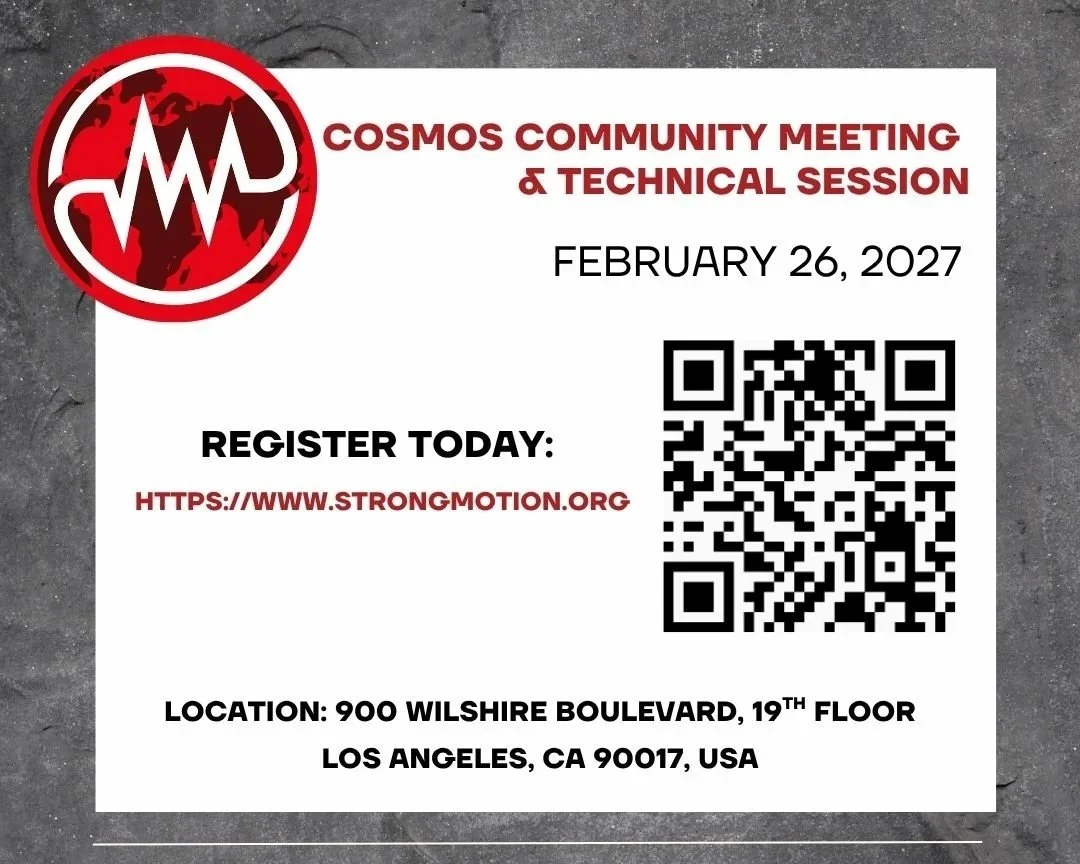
2027 COSMOS Community Meeting & Technical Session
Join us for the 2027 COSMOS Technical Session and Annual Meeting on February 26, 2027, at Arup (900 Wilshire Boulevard, 19th Floor, Los Angeles, California).
This is a hybrid event! Remote/virtual access will be available for participants who are unable to attend in person.
REGISTER TODAY: https://givebutter.com/2027CosmosCommunityMeeting
The theme of the 2027 COSMOS Technical Session is “Research to Practice,” focusing on earthquake science and engineering topics where significant research advances are being made, with clear applications and relevance to improving seismic design and earthquake safety in practice.
Topics will include:
Aftershocks — The role of aftershocks in both long-term forecasting of seismic hazard and risk, as well as shorter-term emergency response and earthquake reconnaissance planning.
Ground Motion Time Series — Advances and emerging questions in the development of ground motion time series for use in the analysis of structural and geotechnical response in research and practice.
Site Response — The state of the art and state of practice in site response, including the implementation of non-ergodic site response procedures in building code applications, and more.
COSMOS, CGS, and USGS Activities — Updates on collaborative activities, including recent workshops related to site characterization and ground motion simulation.
This year’s more focused program is designed to allow additional time for interaction between speakers and participants. Expect plenty of opportunities for Q&A, discussion, and engaging panel conversations throughout the Technical Session.
NEW THIS YEAR: COSMOS will offer Certificates of Completion to assist participants in documenting continuing education hours.
REGISTRANTS will also receive a FREE COSMOS Membership for the year and FREE access to the COSMOS ONLINE SEMINAR SERIES TIME SERIES 101: A Journey from Sensor to Structure
We invite you to join COSMOS in bringing together the global earthquake community to share knowledge, exchange ideas, and strengthen connections across research and practice. Our vision is to elevate the standard of practice for seismic hazard assessment and risk reduction through meaningful discussion, collaboration, and information exchange.
—————————————————————————————————————————————REGISTRATION RATES AND INFORMATION
In-Person One Day (Early-bird) Registration: $250 USD
Virtual One Day Registration: $150 USD
Student (In-person and Virtual): $25 USD
Onsite Registration Fee (After February 15, 2027): $300 USD
https://givebutter.com/2027CosmosCommunityMeeting
—————————————————————————————————————————————
SPONSORSHIP OPPORTUNIES:
https://givebutter.com/2027cosmos-CommunityMeeting-sponsorship-opportunities
—————————————————————————————————————————————
THANK YOU TO OUR EVENT HOST:


COSMOS–ESG7 mHVSR Forum (Pre-Event Forum Meeting)
The COSMOS–ESG7 mHVSR Pre-Event Forum is a full-day international gathering convened by the Consortium of Organizations for Strong-Motion Observation Systems (COSMOS) on the eve of the 7th IASPEI/IAEE International Symposium on the Effects of Surface Geology on Seismic Motion (ESG7), to be held in Grenoble, France, 19–21 October 2026.
The Forum brings together leading researchers, practitioners, and engineers from around the world to advance the state of knowledge, art, and practice in microtremor Horizontal-to-Vertical Spectral Ratio (mHVSR) analysis for evaluating seismic site response.
Building on discussions at the April 2026 SSA Annual Meeting Special Session in Pasadena and on ongoing monthly mHVSR meetings, this Forum is intended to serve as a focused pre-symposium platform for structured debate, community benchmarking, and the development of international guidelines, e.g., the Site EffectS assessment using AMbient Excitations (aka: SESAME v.1.0, 2004) — a "SESAME 2.0" for the modern era.
Context: ESG7 Symposium
The 7th IASPEI/IAEE International Symposium on the Effects of Surface Geology on Seismic Motion (ESG7) will be held 19–21 October 2026 in Grenoble, France. ESG7 explores all facets of site effects on ground motions, including blind prediction exercises on topographic effects and H/V inversion benchmarks. The COSMOS–ESG7 mHVSR Forum is scheduled as a dedicated pre-event on Sunday, 18 October 2026.
Key Topics of the mHVSR Forum
· State of knowledge and practice for mHVSR analyses
· Estimation of fundamental (f₀) and dominant (fd) site frequencies
· Epistemic and aleatoric uncertainties in mHVSR-based site response
· Inversion of mHVSR for shear-wave velocity (VS) profiles and a priori parametric requirements
· Performance and limitations of low-cost sensors for HVSR
· mHVSR characteristics in complex media (e.g. lateral heterogeneity, basin edge effects, 2D resonances)
· International benchmark and new guidelines ("SESAME 2.0")
Organising Committee
Cécile Cornou
Université Grenoble Alpes, France
Aysegül Askan
COSMOS Board of Directors; Middle East Technical University, Ankara, Turkey
Shinichi Matsushima
COSMOS Board of Directors; Kyoto University, Japan
Alexandros Savvaidis
COSMOS Board of Directors; The University of Texas at Austin, USA
Alan Yong
U.S. Geological Survey, USA
Forum Speakers
Francisco Sánchez-Sesma (UNAM) · Jonathan Stewart (UCLA) · Brady Cox (Utah State Univ.) · Joseph Vantassel (Virginia Tech) · Sheri Molnar (UWO) · Albert Kottke (PG&E) · Adrian Rodriguez-Marek (Virginia Tech) · Behzad Hassani (BC Hydro) · Kenneth Hudson (Hudson Geotechnics) · Antony Martin (GeoVision) · Silvia Castellaro (Univ. Bologna) · Marco Pilz (GFZ) · Giovanna Cultrera (INGV) · Fabian Bonilla (Univ. Gustave Eiffel) · Stefano Parolai (Univ. Trieste) · Koichi Hayashi & Hiroshi Kawase (Kyoto Univ.) · Liam Wotherspoon & Chris de la Torre (New Zealand) · and others (TBA).
Registration & Information
This forum is held in conjunction with ESG7 and is open to all registered participants. Attendance is free of charge for ESG7 registrants.
ESG7 Symposium: 19–21 October 2026, Grenoble, France
Forum date: Sunday, 18 October 2026 (full day)
COSMOS: www.strongmotion.org
ESG7: esg2026.inviteo.fr

COSMOS Sim Working Group Workshop at the 13NCEE
Workshop: Earthquake Ground Motion Simulation Validation & Utilization for Engineering Applications
SCEC Organized workshop, collaborations with the COSMOS Sim WG expected: https://www.eeri.org/about-eeri/news/30253-the-13ncee-technical-program-is-now-live
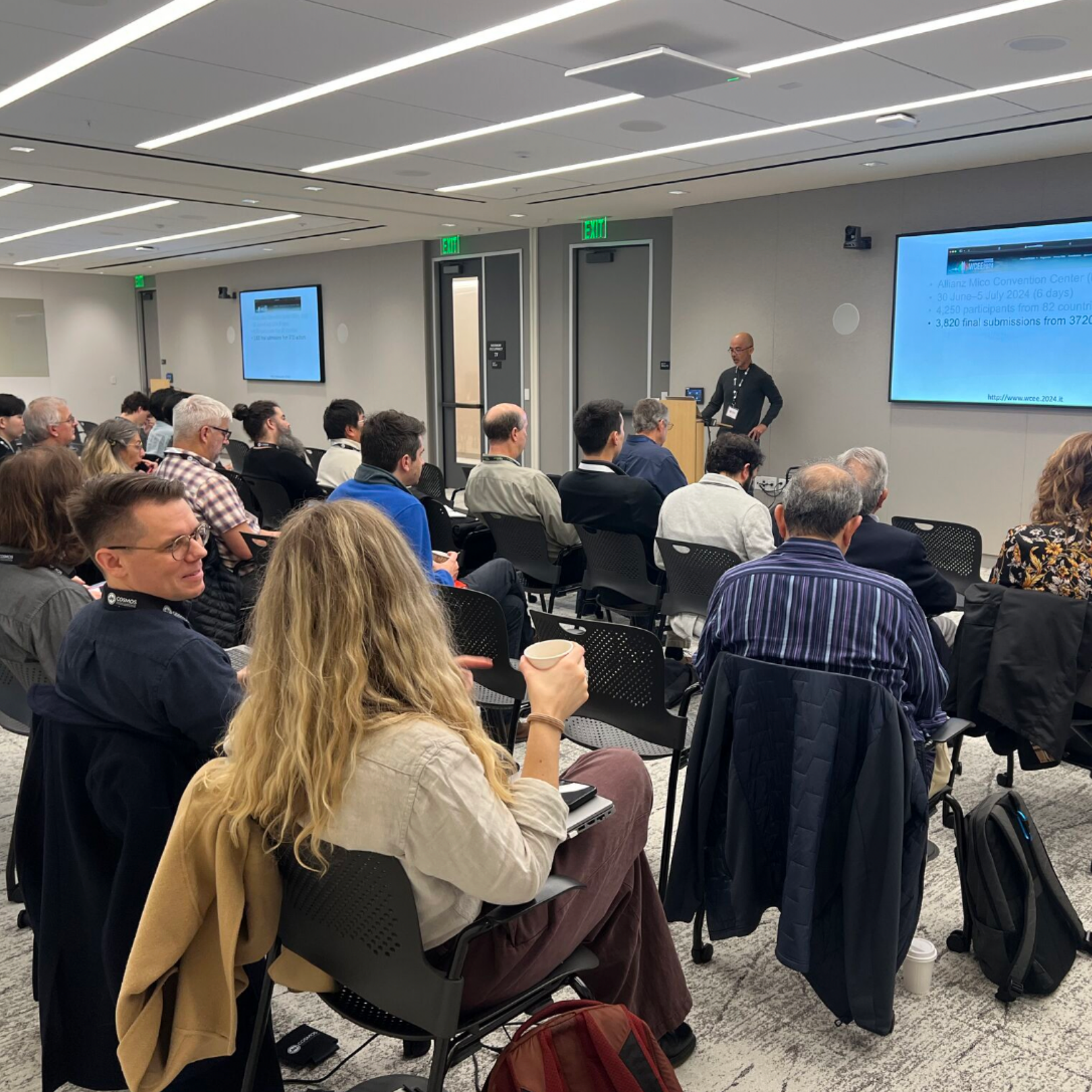
2026 COSMOS Technical Session and Annual Meeting
COSMOS Technical Session and Annual Meeting
February 18-19, 2026 (Hybrid)
Location: 601 12th St, Oakland, CA 94607, USA
Join us for the 2026 COSMOS Technical Session and Annual Meeting. It will be held at the Degenkolb Office Building, 601 12th Street, Second Floor, Oakland, California, 94607 from February 18-19, 2026. Yes, this is a TWO DAY, hybrid event! Remote/virtual access will be available for participants who cannot attend in person.
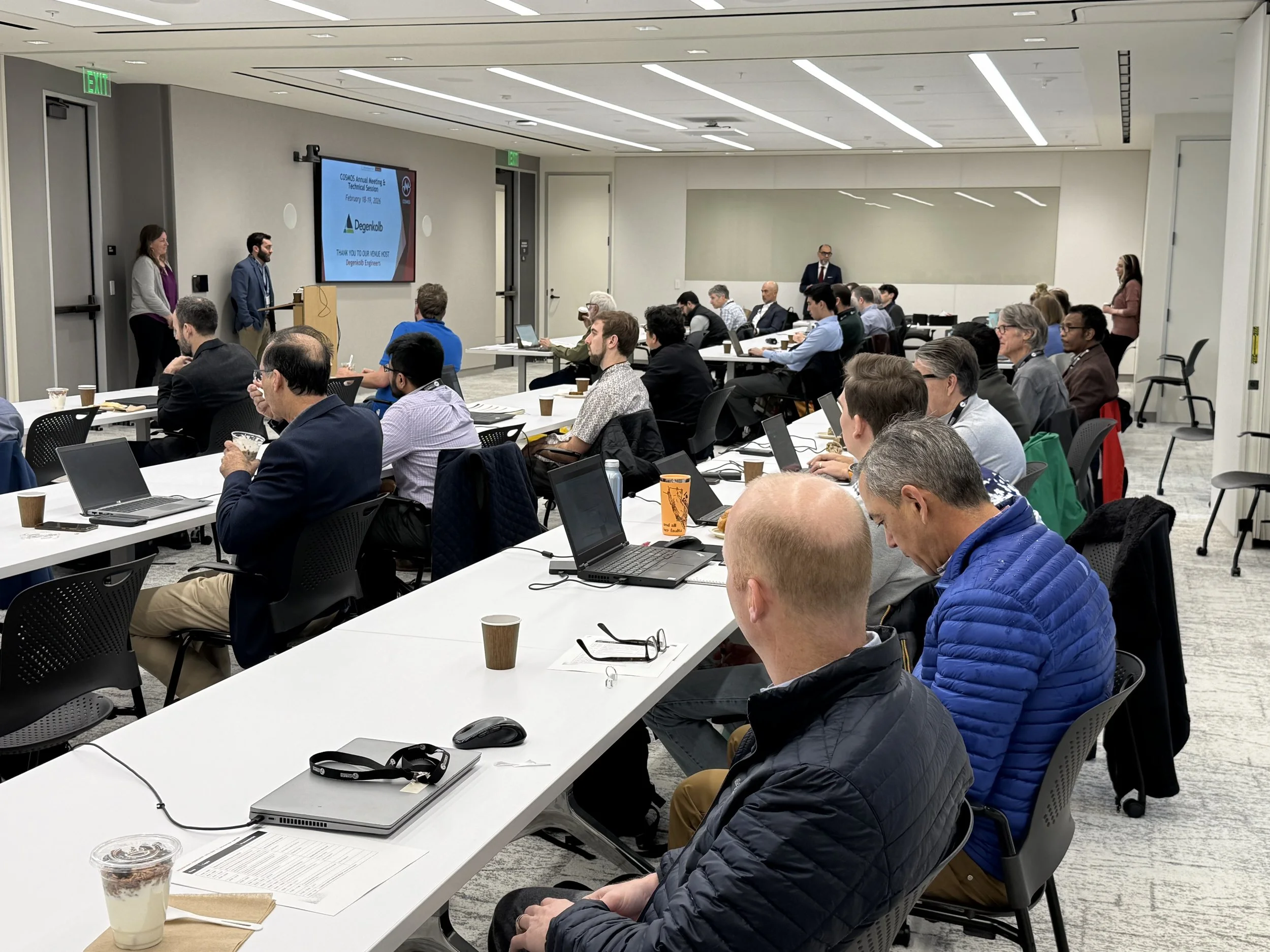
2026 COSMOS Sim WG Workshop
This workshop focused on developing international guidelines and standards for (1) archiving and disseminating, and (2) validating simulated earthquake ground-motion data. This workshop was a mixture of presentations and directed discussions for:
● Developing an inventory of projects related to simulated ground motions,
● Introduction of the proposed COSMOS standard interface for accessing simulated ground-motion data.
Agenda
All dates and times are Pacific Time (UTC-7)
28 January 2026
8:00-8:15 Introduction by Brad Aagaard and Aysegul Askan
8:15-8:30 Ground Motion Simulation Project Inventory by Brad Aagaard
8:30-8:45 Lessons learned from a decade of validation exercises by Sanaz Rezaeian
8:45-9:00 Q/A- All participants
9:00-9:15 Break
9:15-10:00 Brief Overview of Submitted Inventories by a representative of each project
10:00-10:15 Proposed COSMOS Sim WG Standard Interface by Brad Aagaard
10:15-10:45 Open Discussions
10:45-11:00 Future Directions and Closing
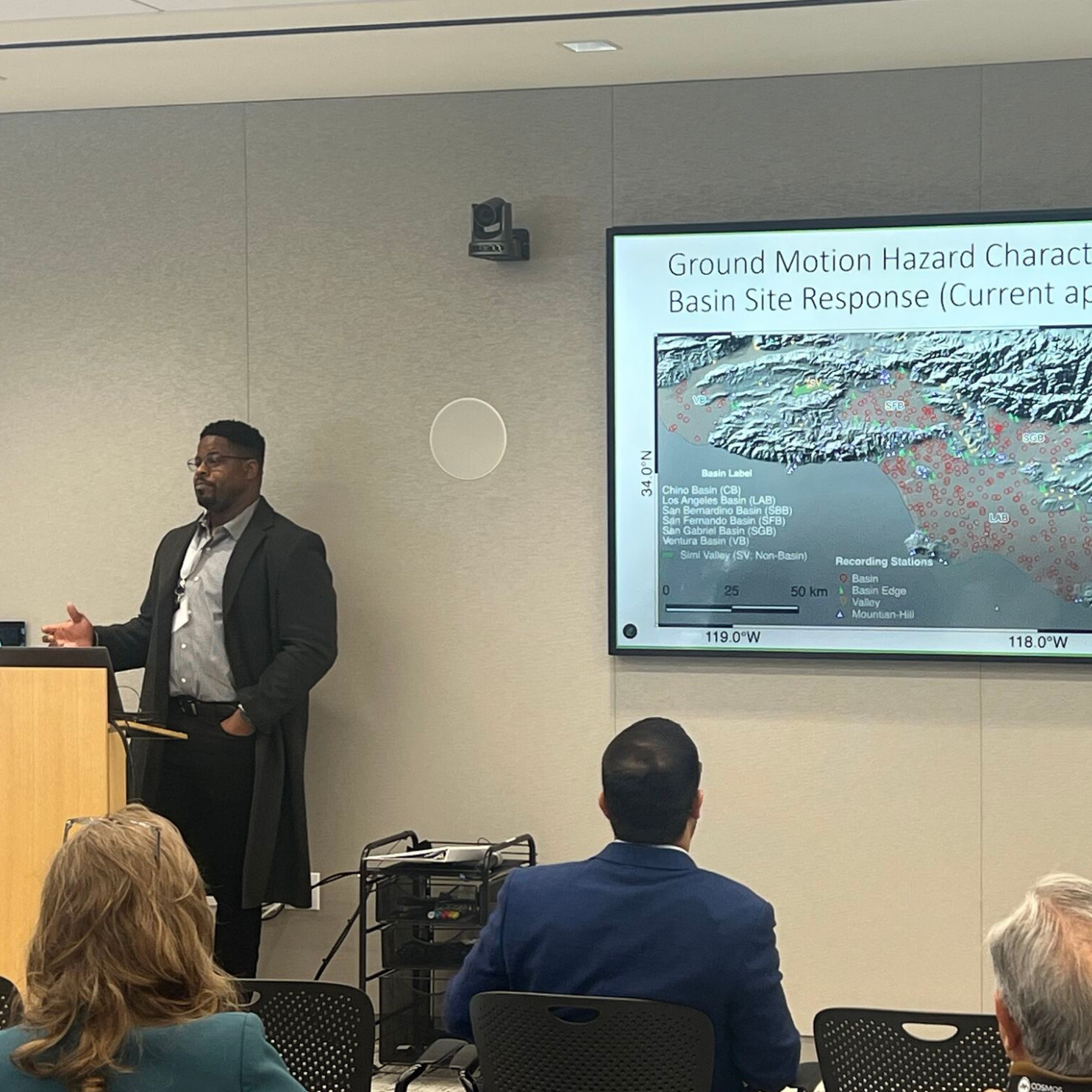
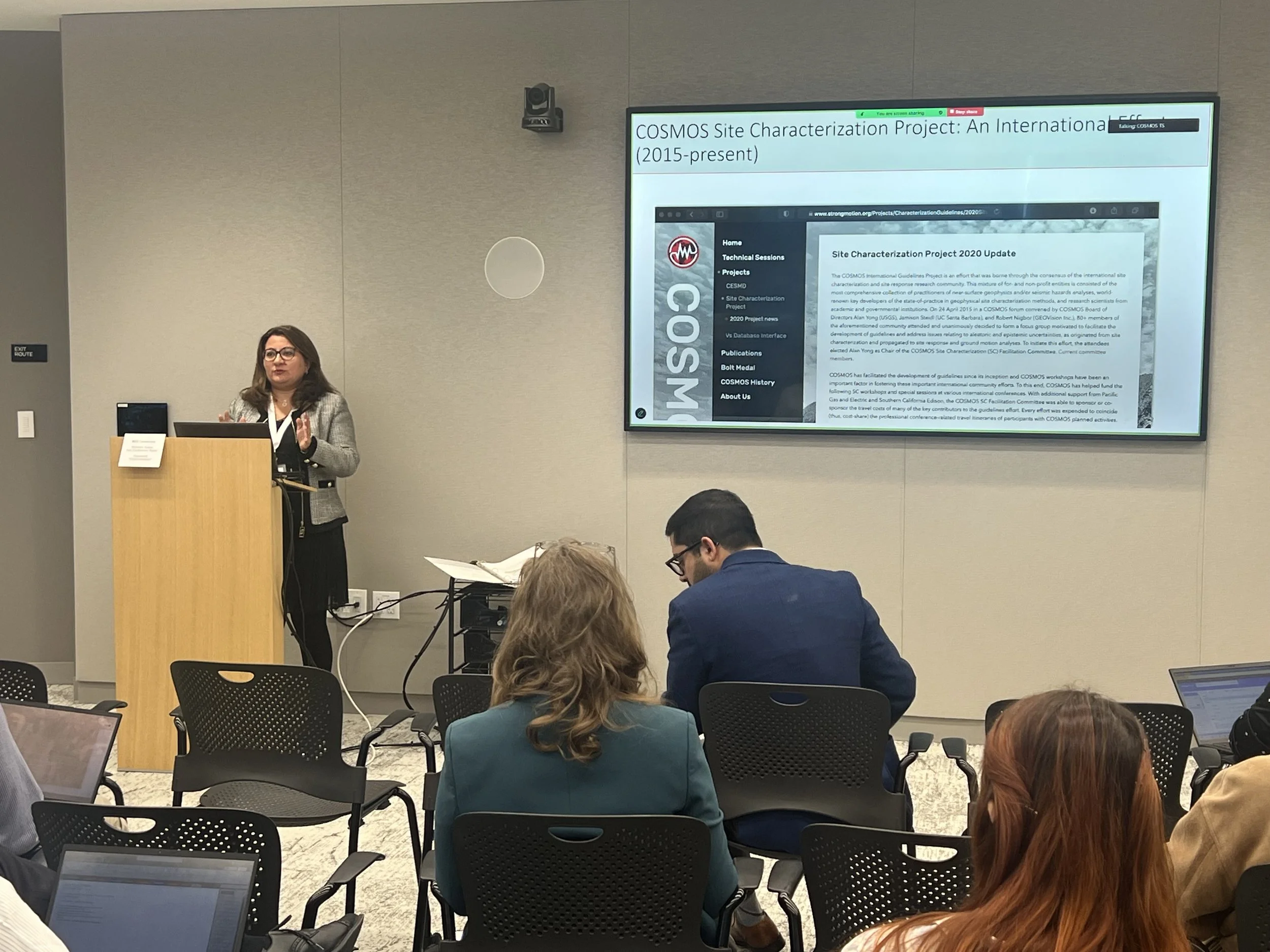
2022 COSMOS Sim WG Workshops
Workshops report (Link)
Workshop #1
This series of workshops focuses on developing international guidelines and standards for (1) archiving and disseminating, and (2) validating simulated earthquake ground-motion data. These workshops are open to anyone interested in these topics.
Workshop #1 will be a mixture of presentations and directed discussions to:
Summarize examples of simulated ground-motion data sets;
Assess the needs of users of simulated ground-motion data in terms of mechanisms for searching and accessing data, and what metadata is needed to describe the simulated data;
Assess what existing strong-motion data center standards and tools might be useful for simulated ground-motion data; and
Outline steps for developing international guidelines and standards for archiving and disseminating simulated ground-motion data.
Agenda
All dates and times are Pacific Time (UTC-7)
7 June 2022
8:00-8:15 Introduction
8:15-9:25 Session I: Examples of Ground-Motion Simulation Data Sets
8:15-8:25 State of SCEC Simulations and their Dissemination by Christine Goulet
8:25-8:35 Simulation Efforts and Database Efforts within PEER by Dave McCallen
8:35-9:05 Summary of Simulation Studies (3 min each)
Japan by Hiroaki Yamanaka
New Zealand by Brendon Bradley
Canada by Behzad Hassani
Pacific Northwest by Erin Wirth
Mexico by Leonardo Ramirez Guzman
Italy by Rodolfo Puglia and Chiara Smerzini
Greece by Basil Margaris
Portugal by Shaghayegh Karimzadeh
Turkey by Aysegul Askan
9:05-9:30 Discussion
9:30-10:00 Break
10:00- 11:40 Session II: Assessing User Needs
10:00- 10:10 Practicing Structural Engineering Perspectives by C.B. Crouse
10:10- 10:20 Academic Structural Engineering Perspectives by Jack Baker
10:20-10:30 Geotechnical Engineering Perspectives by Domniki Assimaki
10:30-10:40 Perspectives for Loss and Impact Modeling by Kuanshi Zhong
10:40-11:00 Summary of COSMOS Survey
11:00-11:30 Discussion
8 June 2022
8:00-8:15 Recap of Day 1
8:15- 9:00 Session III: Archiving Ground-Motion Simulation Data: Data Center Perspectives
8:15-8:25 ORFEUS by Carlo Cauzzi
8:25-8:35 CESMD by Hamid Haddadi
8:35-9:00 Discussion
9:00-9:30 Break
9:30- 11:00 Session IV: Concrete actions towards developing and implementing standards and guidelines for archiving and disseminating simulated ground-motion data
9:30-10:00 Developing standards: Archiving
10:00-10:30 Developing standards: Dissemination
10:30-10:50 Implementing standards
10:50-11:00 Workshop Wrap-up
Workshop #2
This series of workshops focuses on developing international guidelines and standards for (1) archiving and disseminating, and (2) validating simulated earthquake ground-motion data. These workshops are open to anyone interested in these topics. Workshop #2 will be a mixture of presentations and directed discussions to:
● Review the state of the art in validation of simulated motions for engineering applications.
● Summarize lessons learned during past validation efforts.
● Discuss experiences from different regions throughout the world.
● Discuss how to build on existing validation efforts, develop international guidelines for validating simulated motions for engineering applications, and convey validation status of datasets using appropriate metadata.
Agenda
All dates and times are Pacific Time (UTC-7)
20 October 2022
9:00-9:15 Introduction by Aysegul Askan
9:15-9:30 Lessons learned from a decade of validation exercises at SCEC by Sanaz Rezaeian
9:30-9:45 Validation for ground motion characteristics, past, present, and future direction by Jonathan Stewart
9:45-10:00 Validation for structural responses, past, present, and future direction by Nico Luco
10:00-10:15 Validation philosophy for future users of simulations by Christine Goulet
10:15-10:45 Panel discussion with Speakers, led by Farzin Zareian and Nico Luco
10:45-11:15 Break
11:15-11:30 Validation of simulated ground motions from different perspectives: earth sciences and engineering by Luis Dalguer
11:30-11:45 Validation of simulated ground motions in Europe by Chiara Smerzini
11:45-12:00 New Zealand User Guidelines by Brendon Bradley and Jack Baker
12:00-12:30 Panel discussion with Speakers, led by Ertugrul Taciroglu and Brendon Bradley
12:30-13:00 Discussion and Next Steps by Brad Aagaard
